
Get Nerdy for Cartilage Piercings

Cartilage piercings. What defines them? Here at Luna Piercing, we do hundreds of cartilage piercings a year. As one of a few studios in the Connecticut area having Association of Professional Piercers members, we have people of all ages and backgrounds coming in for cartilage piercings - from their first helix piercing to large gauge conch piercings meant to stack hoops in.
When we get a text or call from someone “looking to get a cartilage piercing”, as professionals with the backgrounds we have, we can usually decipher that that person is looking for a helix or flat piercing. But in truth, the majority of the piercings we do in the ear are actually cartilage piercings.

The red area on this ear diagram is the only part that is strictly soft tissue. This area is smaller or larger on different people, depending on their anatomy. Everything else is given structure by rigid cartilage underneath.
All but earlobe piercings go through cartilage, a strong but flexible connective tissue that creates structure in the body that needs to cushion bones, absorb shock, and create supporting structure. There are three types of cartilage in the human body, but Elastic cartilage is the type of cartilage the ear is made of. In this blog post, when we refer to “cartilage”, we will be talking about the elastic cartilage of the outer ear.
Did you know?: All forms of nostril piercings are also cartilage piercings! They go through Hyaline cartilage
The cartilage of your ear is covered by many thin layers that I promise to call by their easier to recognize names
Skin (the epidermal and dermal layer)
An extremely thin layer of fat (subcutaneous adipose tissue)
A specialized layer called the perichondrium (this is the only one you'll have to remember on your own, sorry)
All of these layers have webs of connective fibers that adhere them to each other, bonding the skin to the cartilage.
Okay so... who cares.
Well, you do, because cartilage piercings can take much longer to heal than piercings through soft tissue such as the earlobes.
Cartilage itself is avascular, meaning it doesn’t have any blood vessels. Seventh grade science class be damned, most of us learned that blood flow is very important to the health of live tissue, as well as the repair of it. That’s where the perichondrium comes in. Perichondrium is on the surface of all Elastic and Hyaline cartilage, and you can think of it as a membrane sheath that surrounds the cartilage to help grow and heal. It is extremely porous and fills with blood, becoming the cartilage’s source for nutrients and repair cells through transfusion. Because of the density of cartilage and the limitations of the perichondrium, cartilage heals very slowly.
Most importantly, know that a well healing cartilage piercing will feel normal long before it's healed and ready for jewelry changes on your own. Because the dermal layers heal first and act as a natural cushioning for cartilage tissue, you'll likely find that minor interactions with your piercing don't feel like much of anything before your piercing is actually healed.
It's also important to point out that there are four phases of healing - the third and fourth phases (proliferative and remodeling) both include cellular activity trying to restructure the tissue. At the proliferative stage the majority of swelling is gone, which is what causes the most discomfort. But lattices of collagen are just starting to loosely weave a web for new skin cells to start growing on to cover the fat and cartilage layers. This web is delicate and easily disturbed. Skin cells form long chains and bridges connecting the outer edges of undamaged tissue to undamaged tissue. This can be torn or damaged easily with rough handling, jewelry changes, and poor aftercare. Larger damage from any of these things can set your healing all the way back to the beginning.
Lots of words for “cartilage piercings heal slowly”. So what can we do to heal as quickly and as well as possible? We already have our basic aftercare outlines here, and all of those things do apply! Keeping things clean, dry, and avoiding pressure on your piercing is the key, along with wearing the appropriate jewelry for the full healing time. Remember, it’s the inner layer of cartilage that heals slowly, and everything else remains delicate for up to a year. Things may feel perfectly fine before you’re fully healed, we actually fully expect it to if you're. caring for it properly!
We've got a few tips specific to individual ear piercings, though a lot of this information is helpful across the board.
Rook:

Its standard almost completely across the board to be wearing a curved barbell in a rook piercing, with very few exceptions. Its important to be wearing an appropriately sized piece of jewelry during the healing process so that your jewelry doesn’t spin, which can put pressure on the piercing and cause irritation.
Rooks tend to stay swollen for a long time if irritation occurs. The best thing you can do for a rook (and every piercing, really) is early prevention of irritation vs. treatment.
Tragus & Anti-Tragus:

Both of these piercings can become irritated by headphones, ear pieces, hearing aids and stethoscopes putting pressure on them. The key, if you have to wear them, is finding something that fits without touching your jewelry. It’s also important to clean those items before inserting them every time. We suggest rubbing alcohol for headphones, ear pieces and stethoscopes. Check with your doctor for safe recommendations on disinfectant products and cleaning techniques for hearing aids. Always make sure product is dry before wearing any of these items.
Daith:

Pierced almost exclusively with a ring, though with extreme care, there may be situations where an appropriately fitted curved barbell can work (though the same consideration for jewelry rotation as the rook applies, and jewelry flipping is of LARGE concern. Most piercers highly favoring rings, if not using them exclusively.)
Jewelry in the daith should have a large enough circumference to allow for swelling without distorting the tissue. Because a ring is often able to rotate, be sure to take extra care to keep discharge from drying on the jewelry and rotating through the piercing.
This area can be very tight on a lot of people, and keeping it dry is important. Many clients find that after cleaning or showering, disposable paper products or drying their ear with a blow dryer on the cool setting is better than allowing things to air dry, especially in more humid climates.
Conch:

Because this piercing sits in an often curvy bowl of the ear, it can often accumulate lots of dry skin and leftover hair products, specifically conditioner, especially while wearing larger jewelry. With all piercings we suggest leaving your piercings for last clean up when showering to remove any leftover product, but the conch curvature tends to collect build up quicker here than other areas. Swipe the conch bowl around the piercing (not the piercing directly) with a dry q-tip to prevent this buildup dampening and sticking around.
Snug:
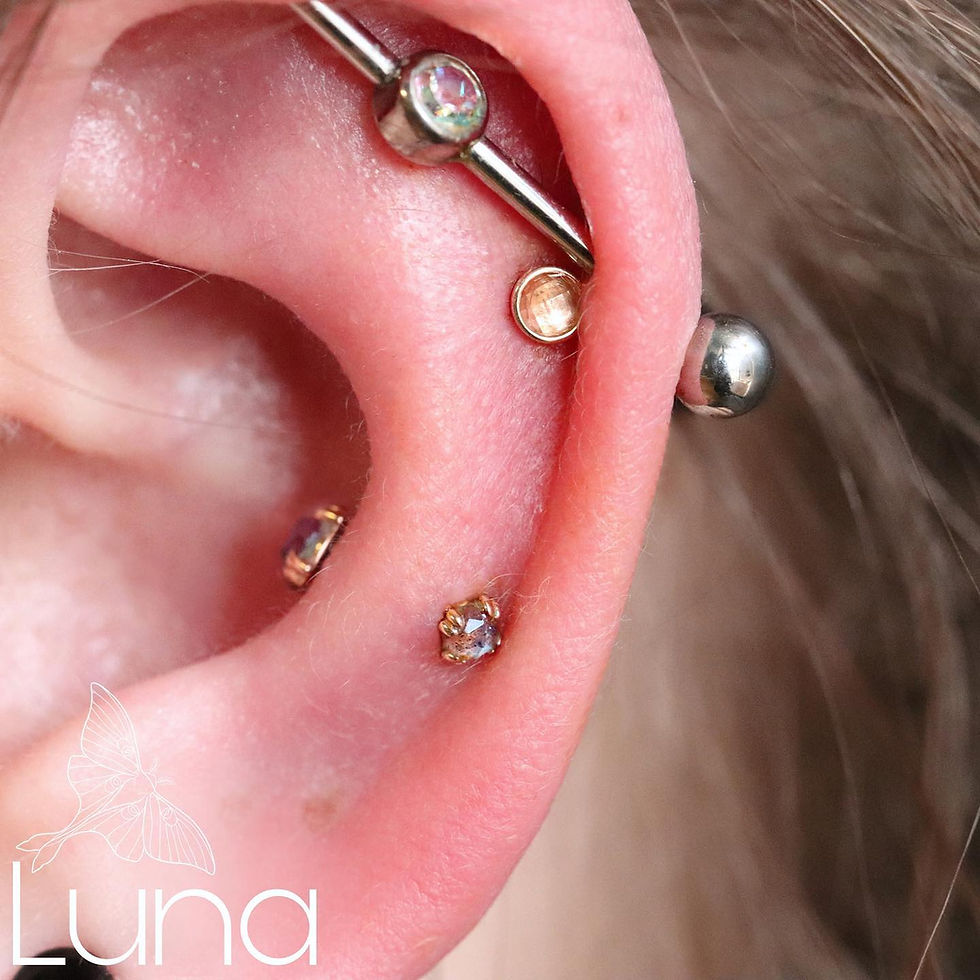
Snug piercings are notoriously a difficult heal, and there are a few good reasons why. The first is that unfortunately not many people are suited for a snug piercing, which requires extremely specific anatomy. The second reason is that it is a thick piece of cartilage that is being pierced through, and that is often the spot that comes in contact with many things because of how far away from the head it sits. Hats, helmets, head coverings, hair styling or rough-housing with children and pets are also something to be mindful of. Snugs are piercings that tend to stay swollen longer once they are initially irritated, which can be hard to recover from.
Industrial & Orbital Piercings:

Because the jewelry of either of these connect two or more piercings, any pressure or blows to the area tend to affect both. These piercings should almost always be fitted with a connecting piece of jewelry initially, otherwise angles can shift during the healing process, creating lasting irritation once connecting jewelry is inserted. Inappropriate angles at the initial piercing can set these up for years of non-linear healing, which may include the potential for short term or long term bumps. Keep pressure off of them! Even using piercing pillows wrong or sleeping on your back in the wrong way can affect both piercings. Keep glasses clean if you wear them, and consider contacts if your glasses touch your jewelry.
Forward Helix:

Helix piercings exit in a very tight area that is important to keep dry and free of hair product. A quick swab of a q-tip after showering to the generalized area behind the forward helix fold keeps moisture from accumulating, though too much pressure or interaction with the jewelry can be irritating to the area. Keeping hair dry, up and away during healing and especially before downsizing is highly important, as it is very easy for hair to wrap around jewelry and hold onto moisture, bacteria, and debris. Wearing properly sized jewelry once your swelling goes down will prevent irritation and snags on clothes and hair. We commonly see a resurgence of swelling if jewelry is not shortened in an appropriate amount of time.
So what if things aren't going well?
An abused, uncared for piercing may react in ways that make clients nervous. Inflammation, drainage, and bumps are things we hear about every day (and to give you some insight, we see these MOST OFTEN from clients who haven't downsized!) The body's immune responses are spectacular, and each of these gives us insight into what may be going on. For now - come see us! We would love to ask you questions, take a peek at what's going on, and get you back on the right path. Perhaps a blog post to come about these sorts of things.
Getting started, revamping, or fixing your piercing journey isn't something you need to figure out alone! Our APP Member team at Luna Piercing is always here to help.
Have more questions or ready to book?
Call or text us at (860)202-3320 to visit our Vernon, Connecticut studio!
Laura, Luna Piercing and Fine Jewelry


Comments